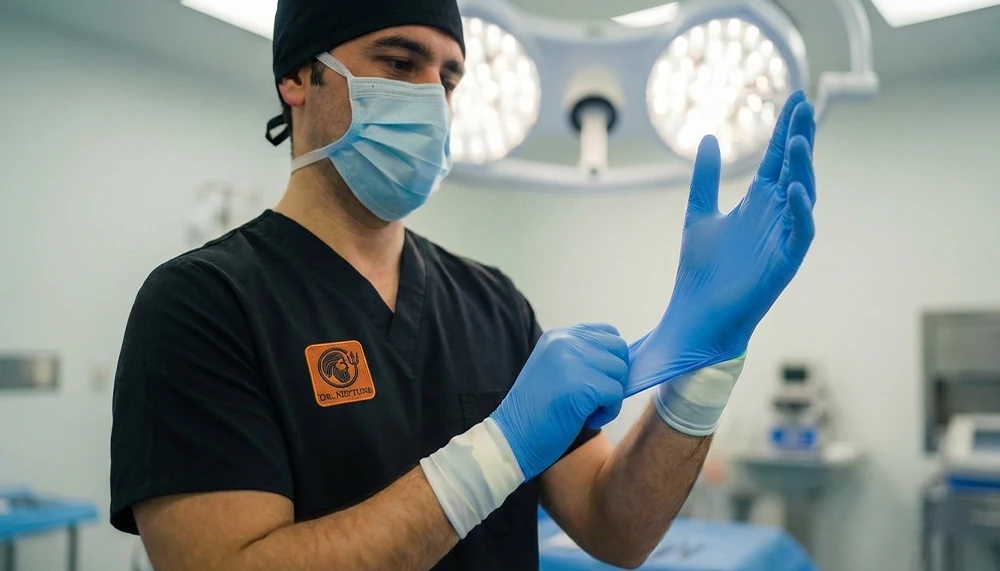
Many patients are unsure who actually performs a hair transplant and who is medically responsible for the procedure. This uncertainty is understandable, because modern hair transplantation is carried out by a team rather than by one person alone.
This article explains, in a clear and practical way, how a hair transplant procedure is organized in reputable clinics. It describes each stage of the treatment, clarifies which steps are normally performed by the doctor and which are commonly handled by trained medical staff, and explains what proper medical supervision means in real clinical practice.
The aim is to help you understand how responsibility is structured during the procedure, what level of transparency you should expect, and how to recognize a medically appropriate treatment process before making a decision.
What does a modern hair transplant really consist of?
A hair transplant is not one single action. It is a medical process made up of several clearly defined stages that follow a structured workflow recognized internationally by professional bodies such as the International Society of Hair Restoration Surgery.
In practice, a standard procedure usually includes:
- medical assessment and planning
- donor area preparation
- local anesthesia
- graft extraction (taking the hair follicles)
- graft preparation and counting
- creation of recipient sites (small openings in the scalp)
- placement of grafts
- medical checks and post-procedure instructions
The most important point is this:
Different steps are performed by different members of the team, but the process itself remains a medical procedure.
In reputable clinics, doctors and trained medical staff work together under a defined structure. They do not replace one another, and they do not perform identical roles.
Which steps are typically doctor-led?
Patients often expect the doctor to perform every part of the procedure. In reality, this is not how most well-organized clinics work.
The doctor’s role is primarily related to:
- medical assessment and eligibility
- examination of the scalp and donor area
- evaluation of hair loss pattern and stability
- treatment planning and hairline design
- medical risk assessment
- clinical oversight of anesthesia
- creation or final approval of the recipient sites
These steps define:
- how the transplant is planned,
- where grafts can be placed safely,
- and how future hair loss is taken into account.
In simple terms:
The doctor is responsible for the medical and strategic parts of the procedure.
This does not mean that the doctor must perform every technical action. It means that medical judgement and planning remain part of medical responsibility.
Which steps are usually performed by the medical team?
In most reputable clinics, trained medical staff such as nurses or certified technicians usually perform:
- graft extraction according to the clinic’s medical protocol
- microscopic graft preparation
- graft sorting and counting
- placement of grafts into the prepared sites
This is standard practice and, by itself, is not a warning sign.
These steps require:
- precision,
- consistency,
- and careful handling of grafts over many hours.
Well-trained teams often perform these stages more efficiently than a single person could.
A more useful question than “Who places the grafts?” is:
Who plans the procedure and takes responsibility for the medical parts of the treatment?
What does proper supervision mean in practice?
Many clinics use the phrase “doctor supervision”. However, this phrase can mean very different things.
In a properly structured clinical setting, supervision usually includes:
- a doctor being available on site during the procedure
- medical involvement in anesthesia and pain control
- review of graft quality and recipient areas during the day
- availability to manage unexpected bleeding, discomfort or medical issues
- a clinical check before the final dressing is applied
Supervision does not necessarily mean that the doctor is physically performing every step.
It means:
Medical responsibility remains clearly defined and accessible throughout the procedure.
This becomes particularly relevant for patients who:
- have sensitive skin or healing problems,
- take regular medication,
- have previous scalp procedures,
- or experience unexpected reactions during treatment.
Standards, licensing and what “legal” really means
The legal structure of hair transplant practice depends on the country in which the clinic operates.
In general, reputable clinics must comply with:
- national healthcare regulations,
- licensing requirements for facilities,
- and professional registration rules for doctors.
For example, in Turkey, clinics operate under the authority of the Republic of Turkey Ministry of Health.
This typically includes:
- licensing of the medical facility
- registration of the responsible physician
- operating room and hygiene standards
- inspection of sterilization and safety procedures
From a patient’s perspective, what matters most is not the country itself, but whether:
- the clinic holds a valid medical operating license,
- the responsible doctor is officially registered,
- and the medical staff are formally trained and employed.
A reputable clinic should be able to confirm this without hesitation.
Required documentation and transparency
Before any procedure, you should receive clear medical documentation.
At minimum, this usually includes:
- a medical history form
- a written consent form
- a description of the procedure
- an explanation of known risks and limitations
- written post-procedure care instructions
You should also be able to ask:
Who is the responsible doctor for my procedure day?
A reputable clinic should be able to provide:
- the name of the responsible physician,
- confirmation of their role in your treatment,
- and an explanation of how the clinical team is organized.
You should also expect:
- pre-procedure photographs,
- a graft number estimate (clearly explained as an estimate, not a guarantee),
- and a defined follow-up plan.
If documentation is handled only by non-medical staff and medical explanations are avoided, this deserves closer attention.
Why aftercare is part of medical responsibility
Many patients assume that the medical part of a hair transplant ends when the last graft is placed.
In reality, aftercare is a continuation of the medical process.
Proper aftercare includes:
- assessment of healing
- monitoring of swelling and redness
- guidance on washing and daily activities
- evaluation of scab formation
- review of early complications if they occur
In reputable clinics:
- healing is reviewed by medical staff,
- photographs are assessed clinically,
- and the doctor becomes involved if recovery is slower than expected or shows unusual signs.
Aftercare is not a customer service function. It is part of responsible medical treatment.
What you should realistically pay attention to before choosing a clinic
A simple checklist can help you evaluate how a clinic works.
What you should expect
- a medical consultation before pricing or booking
- a clear treatment plan and explanation
- transparency about who performs which steps
- written consent and instructions
- a defined medical follow-up process
What you should question
- statements such as “the doctor is supervising” without any explanation
- inability to meet or speak to a doctor before committing
- unclear answers about who creates the recipient sites
- no medical contact after the procedure
Pros of a properly structured clinical team
- consistent technical performance
- safer management of long procedures
- careful handling of grafts
- better coordination during the day
Limitations you should be aware of
- the exact structure can differ between clinics
- legal frameworks vary between countries
- the practical distribution of tasks may not be identical everywhere
This is why a consultation is always necessary.
In practice, what does a normal, well-run procedure day look like?
A simplified and typical example:
- You meet the clinical team and review the plan.
- The treatment area is confirmed and prepared.
- Anesthesia is administered according to medical protocol.
- Graft extraction and preparation are performed by trained staff.
- Recipient sites are created as planned.
- Grafts are placed by the team.
- A final clinical check is performed.
- You receive medical aftercare instructions.
This structure is common in reputable clinics and reflects how modern team-based hair transplantation is organized.
Short summary – what is worth remembering
A hair transplant is a structured medical procedure carried out by a clinical team under the responsibility of a licensed doctor.
The doctor is responsible for medical assessment, treatment planning, critical clinical steps and overall supervision, while trained medical staff perform defined technical stages of the procedure.
Clear documentation, transparent information about roles and proper medical aftercare are essential parts of responsible treatment.
If you are unsure how a clinic organizes its procedures, the appropriate next step is a medical consultation where these responsibilities and processes are clearly explained.