The first two weeks after a hair transplant are not about seeing results. They are about protecting what has just been implanted.
Most early problems after hair transplantation are not caused by the procedure itself. They are usually related to small but important mistakes during recovery, such as touching the grafts too often, sleeping in the wrong position, returning to daily routines too quickly, or misunderstanding how gentle early washing must be.
This practical guide explains what typically happens during the first 14 days of hair transplant recovery after FUE or DHI procedures, and what patients should and should not do at each stage. It is designed for patient education and for use in a clinical information centre.
Why the first 14 days matter
Newly implanted hair grafts are biologically fragile in the early healing phase. They require time to attach to the surrounding tissue and to establish a stable blood supply.
During this period, patient behaviour directly influences:
- comfort during healing,
- cleanliness of the recipient area,
- and mechanical protection of the grafts.
The goal is not perfection. The goal is consistency and gentle care.
Days 0–2: swelling, sleep position and touching rules
These are the first 48 hours after the procedure. This phase focuses on protecting the grafts and managing early swelling.
What you will usually notice It is normal to experience:
- mild swelling of the forehead or around the eyes,
- a tight sensation in the scalp,
- redness in the implanted area,
- light oozing in the donor area.
Swelling often starts on the second day and may slowly move downward from the forehead. Although this can look dramatic, it is usually temporary.
Sleeping position
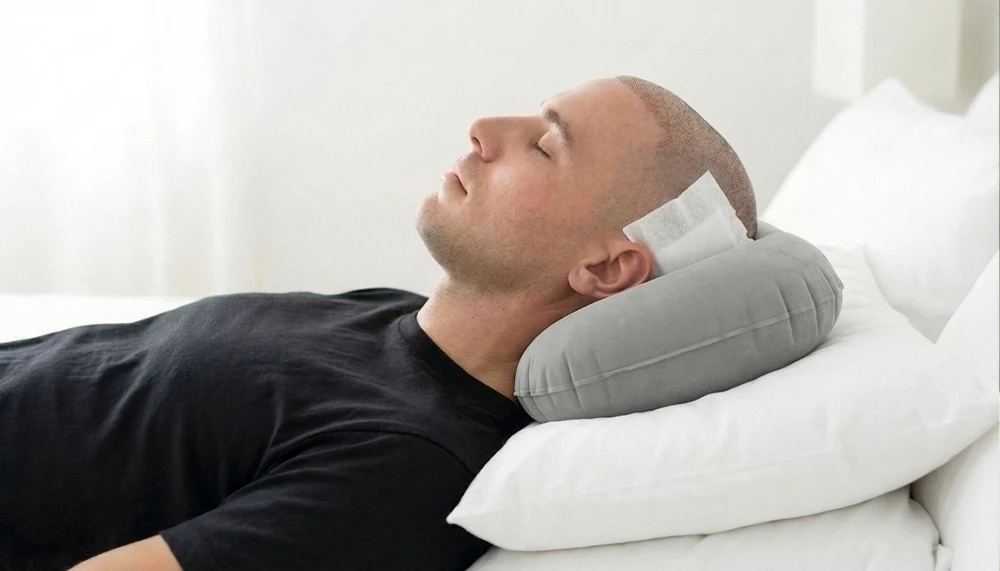
For the first nights, patients should sleep on their back with the head slightly elevated. Avoid:
- lying on the side,
- turning the head into the pillow,
- sleeping face down.
This reduces friction and pressure on the grafts and helps limit swelling.
Touching rules
The most important rule in the first two days is simple: do not touch, rub or scratch the implanted area. Avoid:
- checking grafts with the fingers,
- testing how stable they feel,
- removing small crusts,
- pressing on the scalp.
Even light and repeated contact can irritate the skin and increase the risk of graft disturbance.
Medication and alcohol
During this period, patients are usually prescribed antibiotics and medication for swelling, itching and pain control.
Alcohol should be avoided for the first 7 days. Alcohol can reduce the effectiveness of medication and may increase swelling and dehydration.
Washing during days 0–2
Washing usually begins once permitted by the treating clinic. A key principle is that gentle and regular cleansing protects the scalp rather than harming the grafts. Patients are typically instructed to follow a structured, low-pressure washing technique from the early recovery stage.
Days 0–2 – do and don’t
Do
- sleep on your back with your head elevated,
- follow your medication schedule,
- keep the scalp clean as instructed,
- limit physical activity.
Don’t
- touch or rub the implanted area,
- wear hats or helmets,
- consume alcohol,
- exercise,
- expose the scalp to direct sunlight.
Days 3–7: washing, scabs and a light daily routine
This is the period when many patients start to feel more comfortable and mobile. It is also the phase when small mistakes most often occur.
Washing twice daily
From day three onward, washing becomes a central part of proper post hair transplant care.
Washing twice a day helps to:
- remove dried blood and excess oil,
- reduce heavy crust formation,
- maintain a clean healing environment.
Gentle washing does not damage grafts when performed correctly. In fact, avoiding washing can make later scab removal more difficult.
Important principles:
- no rubbing or scratching,
- no high water pressure,
- no hot water,
- no direct shower stream onto the implanted area.
Fingertips should only lightly touch the skin and shampoo should be distributed gently rather than massaged.
Scabs: what is normal
Small crusts around grafts are normal. During this period, they usually soften and gradually detach. Scabs should not be removed manually.
Forcing them off can:
- irritate the skin,
- prolong redness,
- and, in rare cases, disturb fragile grafts.
With consistent gentle washing, scabs usually loosen naturally.
Daily activity
Light daily activities can be resumed, including:
- slow walking,
- light household tasks,
- short outdoor trips.
Patients should still avoid:
- prolonged bending forward,
- lifting heavy objects,
- activities that cause heavy sweating.
Excess sweating can irritate healing skin and increase itching and inflammation.
Sleeping and posture
Sleeping on the back remains recommended throughout this period to avoid unnecessary pressure and friction.
Days 3–7 – do and don’t
Do
- wash the scalp twice daily using the recommended technique,
- continue sleeping on your back,
- take short walks,
- keep the scalp clean and dry between washes,
- avoid dusty or smoky environments.
Don’t
- scratch or pick at scabs,
- return to gym or sports,
- drink alcohol,
- expose the scalp to direct sun.
Days 8–14: work, exercise and sun exposure
By the second week, redness usually decreases and most crusts are gone. Many patients begin to feel almost back to normal.
Returning to work
Most patients can return to office-based or non-physical work during this period.
If work involves heavy physical activity, helmet use or prolonged sun exposure, timing should be discussed with the treating clinic.
Exercise and sports
During days 8–14, patients should still avoid:
- intense cardio,
- strength training,
- contact sports,
- swimming,
- sauna or steam rooms.
Although grafts are becoming more stable, heavy sweating and repeated head movement can still irritate healing skin.
Light walking remains acceptable.
Sun exposure
Limiting sun exposure is one of the most underestimated recovery rules.
Direct sunlight can:
- irritate sensitive skin,
- increase redness and pigmentation changes,
- slow skin recovery.
During the first two weeks:
- avoid direct sunlight on the scalp,
- avoid long outdoor stays during strong sun,
- do not apply sunscreen directly onto the implanted area unless specifically approved by your clinic.
Washing during days 8–14
Twice-daily washing should usually continue.
At this stage:
- most scabs should be gone,
- the scalp should feel softer and cleaner,
- mild itching may still be present.
Some clinics gradually adjust washing technique after the first 10 days, depending on individual healing and residual crusting. Any change in washing method should follow professional guidance.
Clear recovery checklist
Do
- wash the scalp twice daily using the recommended technique,
- sleep on your back for the first two weeks,
- complete all prescribed medication,
- protect the scalp from direct sunlight,
- keep physical activity minimal,
- stay well hydrated,
- attend all scheduled follow-up appointments.
Don’t
- touch, rub or scratch the implanted area,
- pick or peel scabs,
- perform strenuous activity,
- drink alcohol during the first 7 days of medication,
- expose the scalp to heat, steam or strong sun,
- return to heavy physical work without medical approval.
Warning signs – when to contact your clinic
Most recovery symptoms are mild and temporary.
Patients should contact their clinic if they experience:
- increasing pain that does not improve with prescribed medication,
- expanding redness around the donor or recipient area,
- yellow discharge or unpleasant odor from the scalp,
- fever or flu-like symptoms,
- sudden or worsening swelling,
- any clear signs of infection.
Early communication is always safer than waiting.
Common misunderstandings during early recovery
“If I touch the grafts gently, nothing will happen.”
Repeated light touching can still irritate the skin and increase inflammation. Hands also introduce bacteria.
“If I avoid washing, I protect the grafts.”
Poor hygiene increases crust formation and irritation. Proper washing is protective.
“If I feel well, I can return to sports earlier.”
Feeling well does not mean the scalp is ready for physical stress.
A realistic note about graft stability
Hair grafts do not become fully secure on a single specific day. They gradually anchor into the scalp over time.
By the end of the second week, the risk of mechanical displacement is significantly lower, but skin healing and inflammation control are still ongoing. Consistent care during the first 14 days remains essential.
Short summary
The first 14 days after a hair transplant are focused on protection, hygiene and patience.
Sleeping on the back, washing the scalp twice daily, limiting physical activity and avoiding direct sun exposure are the most important daily rules.
Because patients commonly use antibiotics and anti‑swelling medication during the early recovery period, alcohol should be avoided for the first 7 days.
Most early recovery issues are related to temporary discomfort and routine adjustments rather than medical complications. Any unusual or concerning symptoms should be discussed with the treating clinic.