One of the first questions almost every patient asks is very simple: “How many grafts will I need?”
The confusing part is that the answers you see online are often completely different. One website suggests 2,000 grafts. Another suggests 3,500. A calculator tells you something else again.
This article explains, in clear and realistic terms, what a graft actually is, what truly determines the number you need, and why a reliable graft count can not be produced by a generic online form.
What a graft really is (and what it is not)
A graft is not the same as a hair.
A graft is a small natural unit of hair follicles taken from the donor area. Each graft may contain:
- one hair,
- two hairs,
- three hairs,
- and occasionally more.
This matters because the visual result you see on the scalp depends on how many hairs are growing — not only how many grafts were implanted.
Two people can both receive 2,500 grafts and end up with very different cosmetic density simply because:
- one patient’s grafts contain mostly two and three hairs,
- while another patient’s grafts contain mostly single hairs.
So when you hear a graft number, you are not hearing the full story. You are hearing only the container, not what is inside it.
That is the first reason why graft planning is not a fixed formula.
Why graft numbers cannot be guessed from baldness alone
It is tempting to think that the size of the bald area automatically tells you how many grafts you need.
In reality, the visible bald area is only one part of the calculation.
Two patients with similar-looking hair loss can require very different graft numbers because the underlying hair characteristics and cosmetic goals are not the same.
A good estimate always starts with understanding how much visual coverage is needed - not how much skin is visible.
The real factors that influence your graft count
Several variables shape the final graft plan. None of them can be evaluated correctly through an online form.
The most important ones are:
- the width and shape of the area to be treated,
- your natural hair calibre (thickness of each hair),
- how many hairs are usually contained in your grafts,
- the color contrast between your hair and your skin,
- the direction and angle of your existing hair,
- the level of follicular miniaturisation in the surrounding zones,
- and how aggressive or conservative the design should be.
For example:
A patient with thick, wavy hair and low contrast between hair and scalp usually requires fewer grafts to create the same visual coverage than a patient with straight, very fine hair and high contrast.
This is not about quality. It is about optics.
Hair transplantation is partly surgery and partly visual engineering.
Typical graft ranges by area
While every plan must be individual, it is still useful to understand what realistic ranges look like in daily practice.
The numbers below are not promises. They are broad reference ranges.
Hairline and frontal zone
The frontal area is usually treated with controlled density and very careful angulation.
In many patients, this area typically requires: approximately 1,200 to 2,000 grafts
The exact number depends on: • how wide the frontal recession is, • whether the temporal recessions are included, • and how low or conservative the hairline design should be.
Temples
The temple points are small, but technically demanding.
They often require: approximately 150 to 350 grafts per side
This area usually prioritises natural direction and softness over sheer density.
Crown
The crown is visually deceptive.
Although it looks like a small circular area, it often consumes a large number of grafts due to the spiral growth pattern.
In many patients, the crown typically requires: approximately 800 to 1,500 grafts
Larger crowns may require significantly more.
It is also important to understand that achieving full cosmetic density in the crown in one session is rarely realistic.
Why online graft calculators give you different answers
Online graft calculators usually rely on two or three simple inputs, such as:
- age,
- degree of hair loss,
- and sometimes the shape of the bald area.
They do not evaluate:
- your donor quality,
- your hair calibre,
- your follicular unit composition,
- or your long-term hair loss pattern.
As a result, these tools can only generate an average number.
That average may be very far from what is appropriate for your scalp.
Different websites use different internal assumptions. That is why the same person can receive completely different numbers from different calculators.
Online tools can be helpful for general orientation, but they should never be treated as a planning instrument.
Why density is not simply “grafts per square centimetre”
You may see clinics advertise fixed density numbers such as:
“X grafts per square centimetre”.
In reality, density planning is not uniform across the scalp.
Different zones require different approaches.
For example:
- the hairline needs softer, irregular distribution,
- the mid-scalp usually allows slightly higher packing,
- and the crown needs pattern-based placement that follows the natural swirl.
Placing the same number of grafts per square centimetre everywhere would look artificial and often waste valuable donor resources.
A well-designed transplant uses grafts strategically, not evenly.
The donor area: the silent limitation
Many patients focus only on how many grafts they want.
The more important question is how many grafts can be taken safely.
Your donor area has a finite supply.
That supply depends on:
- donor density,
- hair thickness,
- scalp elasticity,
- and the safe extraction zone.
If too many grafts are taken from a limited donor area, the back and sides of the scalp may start to look thin.
A responsible plan always balances two realities:
- the coverage you would like to create,
- and the donor reserve you will need in the future.
This is especially important for younger patients and for patients with progressive hair loss.
A simple way to think about graft planning in practice
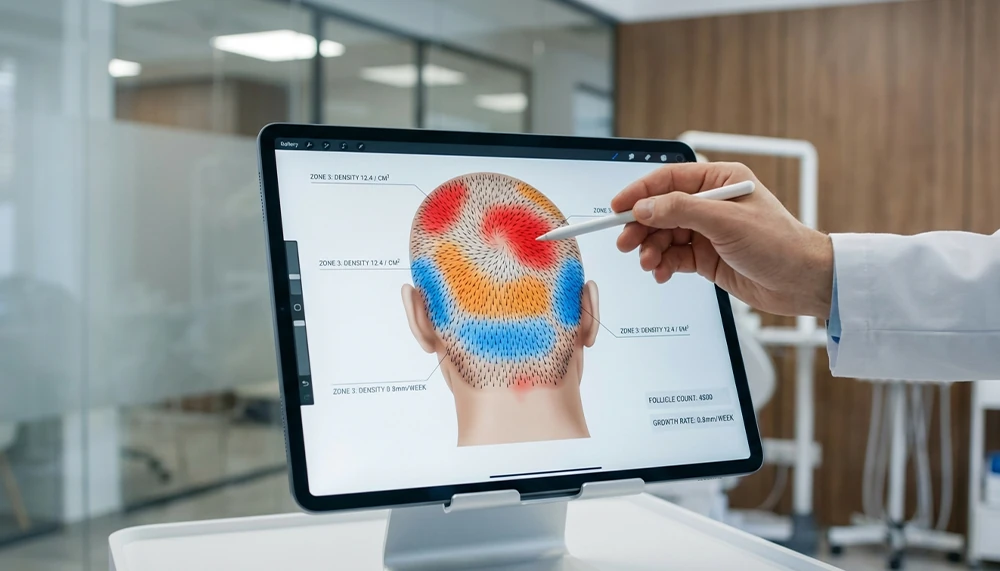
A practical way to understand graft estimation is to break the scalp into visual zones.
Each zone is evaluated separately:
- how large it is,
- how visible it is in daily life,
- how much existing hair is present,
- and how important it is to your appearance.
The frontal frame of the face usually carries more visual weight than the crown.
This is why grafts are often prioritized for the front, even when the crown is also thin.
The aim is not to fill everything equally.
The aim is to create the most natural and sustainable visual improvement.
Why two specialists can recommend different graft numbers
It is not unusual for patients to receive different graft recommendations from different clinics.
This does not automatically mean that one of them is wrong.
Different specialists may:
- design the hairline at a different height,
- include or exclude certain zones,
- plan for a staged approach,
- or reserve more donor grafts for the future.
Graft numbers reflect planning philosophy as much as they reflect anatomy.
That is why you should always ask:
- which areas are included in the proposed number,
- what density approach is being used,
- and whether the plan accounts for future hair loss.
When and why professional evaluation becomes necessary
A reliable graft estimate requires direct examination.
This includes:
- close inspection of donor density,
- evaluation of hair thickness and shaft structure,
- assessment of miniaturisation in the recipient and donor zones,
- and realistic long-term planning.
Photos alone often fail to show:
- subtle thinning patterns,
- diffuse miniaturisation,
- or limitations of the donor area.
Without this information, any graft number remains a rough guess.
Professional evaluation is not only about counting grafts.
It is about deciding how to use a limited biological resource wisely.
A short reality check for patients
There is no universal “correct” graft number for a given level of hair loss.
There is only a number that makes sense for:
- your scalp,
- your hair characteristics,
- your future risk of further loss,
- and your personal expectations.
Treat any fixed number you receive without examination with caution.
Summary
A graft is a natural follicular unit, not a single hair.
The number of grafts you need depends on multiple visual and biological factors, not only on how bald an area looks.
Typical ranges exist for the hairline, temples and crown, but they are only reference points.
Online calculators use simplified assumptions and often produce very different results for the same person.
A proper graft estimate requires professional assessment of both the recipient area and the donor reserve.
If you are considering a hair transplant, the most reliable next step is a personalized evaluation that looks beyond numbers and focuses on what is realistically achievable for your scalp.