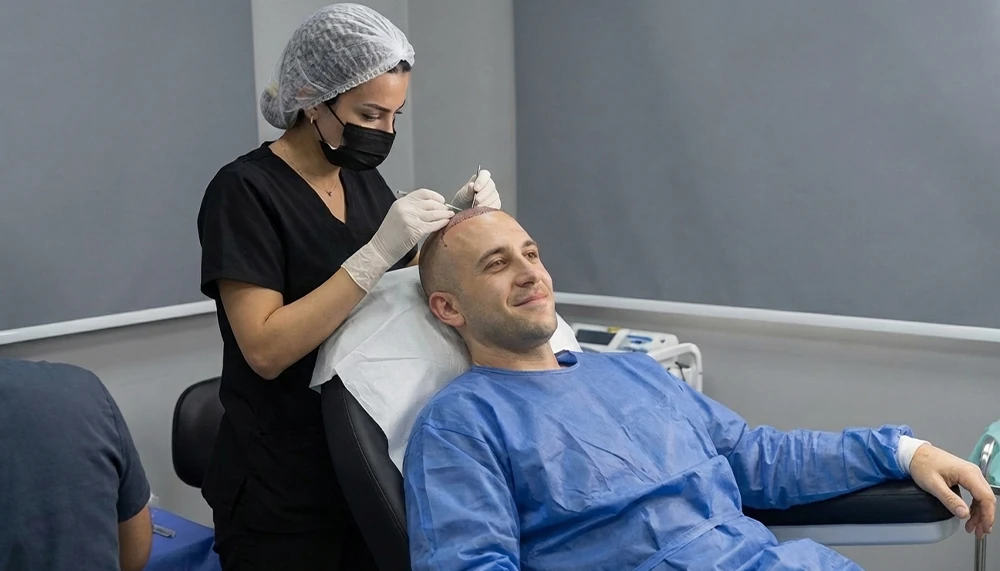
One of the first questions almost every patient asks is very simple:
Will it hurt?
This article explains honestly what most patients experience in terms of pain and discomfort before, during and after a hair transplant, what usually causes unpleasant sensations, and how pain is managed in real clinical practice.
The aim is not to promise a completely pain-free procedure, but to help you understand what is realistic and what usually matters most during recovery.
Does a hair transplant look more painful than it really is?
For many people, the idea of a hair transplant feels more frightening than the reality.
Videos, medical tools and close-up images often make the procedure look intense. In practice, most patients say the treatment looks much worse than it actually feels.
What usually surprises patients is that:
- the procedure takes several hours,
- they stay in one position for a long time,
- and they need to protect the implanted area carefully afterwards.
In most cases, pain itself is not the main issue.
What does pain feel like during the procedure?
The part that can cause short-lasting discomfort is the local anesthetic injections.
Once the anesthesia takes effect, the scalp becomes numb and both extraction and implantation are usually painless.
In professional clinics such as Dr. Neptune,Lş. patients receive an intravenous (IV) drip during the procedure.
This IV support includes medication for:
- pain relief,
- allergy prevention,
- and swelling control.
The purpose is not sedation, but comfort and stability during a long procedure. Most patients feel very relaxed, and many of them fall asleep during the treatment.
After the scalp is numb, patients usually feel:
- light pressure,
- mild pulling sensations,
- or vibration,
rather than pain.
Is pain a problem after the hair transplant?
A very common fear is having a painful first night after the procedure.
In reality, in almost all cases, pain is not the main difficulty after a hair transplant. The more common experience is general discomfort.
At our clinic, we apply an additional pain-relief injection at the end of the procedure. This is specifically done to help patients feel more comfortable after the treatment and to reduce the chance of discomfort during the first night, which is often what patients worry about most.
In addition, patients receive medication to control pain at home if needed.
Why sleeping position is usually more uncomfortable than pain
For most patients, the most challenging part of the first days is not pain, but posture.
After a hair transplant, patients are advised to sleep on their back and avoid turning to the side or lying face down. This protects the newly implanted grafts and helps reduce swelling.
For people who normally sleep on their side or stomach, this can feel uncomfortable.
The most frequent complaints are:
- neck and shoulder stiffness,
- difficulty falling asleep,
- and waking up often during the night.
To help with this, we provide a hygienic support pillow that helps maintain the recommended sleeping position and reduces pressure on the treated areas.
What actually causes discomfort after a hair transplant?
It is helpful to separate pain from discomfort.
In daily clinical practice, discomfort after a hair transplant usually comes from:
- staying in one position for several hours during the procedure,
- temporary swelling of the scalp or forehead,
- tightness in the donor area,
- and the need to sleep on the back without turning.
Sharp or strong pain is uncommon.
How pain and comfort are managed at our clinic
Comfort management is planned as part of the treatment.
At our clinic, this includes:
- an IV drip during the procedure containing pain-relief, anti-allergy and anti-swelling medication,
- careful local anesthesia throughout the procedure,
- a pain-relief injection given after the procedure to make the first hours and the first night more comfortable,
- and take-home medication in case pain or discomfort appears.
This approach allows most patients to remain relaxed during the treatment and to recover without significant pain.
What you can and cannot expect in terms of pain (checklist)
You can usually expect:
- brief discomfort during the anesthetic injections,
- pressure or pulling sensations rather than pain during the procedure,
- mild tightness in the donor area,
- and general body stiffness after a long session.
You should not expect:
- continuous or strong pain during the procedure,
- severe pain during the first couple of days in most cases,
- or the need for strong pain medication for many days.
Any unusual or increasing pain should always be reported to the clinic.
Common misconceptions about pain and hair transplantation
“A hair transplant is very painful”
Most patients describe the procedure as long, but not painful.
“The first night is always very painful”
This is a common fear, but it is usually not supported by patient experience.
“If I only feel discomfort, something is wrong”
Discomfort, tightness and stiffness are normal parts of early recovery.Strong pain is not expected.
When pain can feel different
Pain perception varies from person to person.
Some patients are more sensitive to:
- injections,
- swelling,
- or scalp tension.
Long sessions and large treatment areas can also slightly increase post-procedure discomfort.
This is why individual consultation and personalized planning are important.
Short summary
A hair transplant usually looks more painful than it really is.
In most cases, pain is not the main issue patients deal with; general discomfort and sleeping position are more relevant.
At our clinic, comfort is supported with IV medication during the procedure and an additional pain- relief injection after the treatment to make the first hours and night more comfortable.
Patients also receive medication for home use and a hygienic support pillow to help them sleep safely on their back during the first nights.