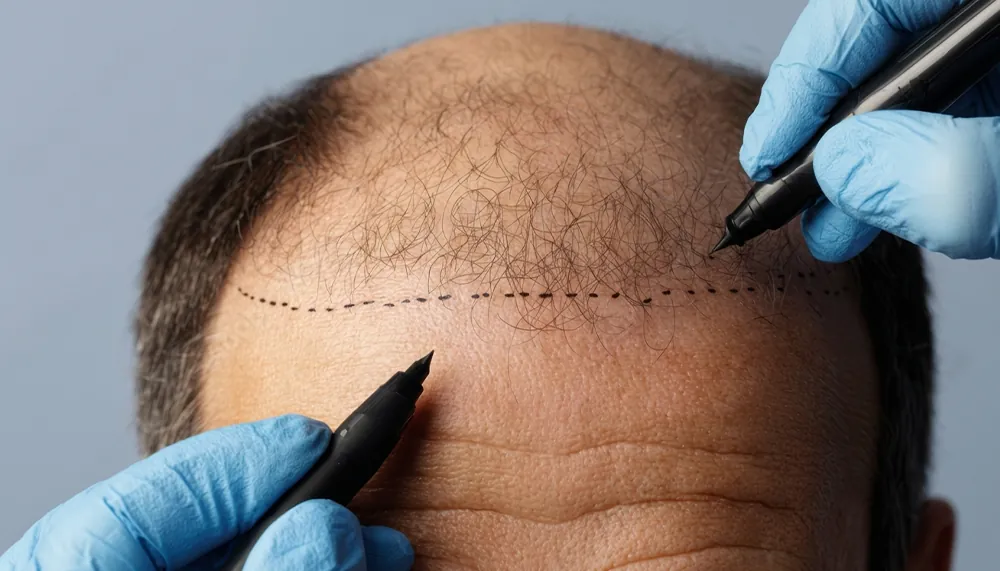
Choosing a hair transplant method can feel confusing. Many clinics use technical terms and marketing language, but for most people the real question is simple: which method fits my hair loss pattern and expectations best?
This article explains what DHI and FUE really mean, how they differ in everyday clinical practice, and which method is usually more suitable for the hairline, crown and diffuse thinning. The aim is to help you understand your options clearly and decide what your next step should be.
What do DHI and FUE actually mean?
Both DHI and FUE are based on the same principle: hair follicles are taken one by one from the donor area, usually from the back of the scalp, and transferred to areas with thinning or no hair.
The difference is not how the grafts are removed. In modern practice, both methods usually use the same FUE extraction technique.
The real difference is how the grafts are implanted.
What is FUE implantation?
With classic FUE implantation, the process usually follows two steps:
- first, small recipient incisions (channels) are created in the scalp,
- then the grafts are placed into those channels using forceps.
In simple words: the spaces are created first, and the hair is inserted afterwards.
What is DHI?
DHI stands for Direct Hair Implantation.
With DHI, the graft is implanted directly into the scalp using a special implantation pen. There is no separate phase in which channels are opened in advance.
In simple words: the graft is placed in one controlled movement.
This allows continuous control of:
- depth,
- angle,
- and direction
at the exact moment of implantation.
How the two methods differ in real treatment
The most important practical difference between DHI and classic FUE implantation is how the tissue is handled during placement.
With channel-based implantation, all incisions are created first. Their position, angle and spacing are fixed before any graft is placed.
With true DHI implantation, each graft is placed directly into intact skin using an implantation pen. This allows the specialist to control the position and orientation of every graft in real time.
A key clinical advantage of this approach is often overlooked:
because there are no pre-opened incisions, there is no risk that neighbouring channels will merge into each other.
This means that, when medically appropriate:
- grafts can be placed very close to one another,
- spacing can be adjusted instantly,
- and compact, visually stronger density can be created in selected areas.
This is one of the main technical reasons why DHI allows a thicker and more controlled implantation, especially in visually sensitive zones.
Who each method is best for (hairline, crown and diffuse thinning)
Different parts of the scalp require different implantation strategies.
Hairline restoration
The hairline is the most demanding area in a hair transplant. A natural result depends on very precise angles, soft transitions and small, controlled irregularities.
With classic channel opening, a safety distance between incisions is required to avoid overlap and tissue instability.
This limits how closely grafts can be positioned.
With DHI:
- there is no concern about incisions merging,
- grafts can be placed very close to each other when needed,
- and angle and direction can be adjusted for every single graft during placement.
In practice, this allows:
- softer and more compact frontal transitions,
- better control of micro-direction changes along the hairline,
- and safer dense packing in selected zones.
For patients whose main goal is a natural and dense frontal appearance, DHI is usually the more suitable option.
Crown (vertex) area
The crown has a circular and changing growth pattern. Small errors in direction become visible when the hair grows out.
Both FUE implantation and DHI can be used in the crown. However, DHI offers greater flexibility to follow the natural swirl because direction and angle can be adjusted continuously during placement.
This is especially helpful in:
- small to medium crown restorations,
- refinement and correction cases,
- and situations where accurate orientation is more important than covering a very large area.
Diffuse thinning
In diffuse thinning, many native hairs are still present and the main goal is to increase thickness without damaging existing hair.
With channel-based implantation, working between existing hairs is more challenging and may increase the risk of unnecessary trauma and damage to the existing hair.
With DHI:
- grafts can be placed directly into selected micro-spaces,
- existing hairs can be avoided more easily,
- and placement can be adapted to local tissue resistance.
For patients who still have a significant amount of their own hair and mainly need controlled thickening, DHI is usually the safer and more precise choice.
Pros and cons: scarring, healing time, density and cost factors
DHI – main advantages
- continuous control of angle, direction and depth during implantation
- safer dense packing because there is no risk of incisions merging
- lower likelihood of visible scarring in the recipient area
- reduced risk of infection, as there are no open channels to heal
- often more comfortable healing in the implanted area
- very suitable for hairline design and refinement work
- safer implantation between existing hairs
DHI – possible limitations
- requires a highly trained and well-coordinated team
- the procedure may take longer
- not every clinic performs true DHI
- treatment costs can be higher due to equipment and staffing requirements
FUE implantation – main advantages
- widely available and well established
- suitable for large graft numbers
- reliable option for broad coverage
- can be efficient for extensive bald areas
FUE implantation – possible limitations
- angle and direction are fixed at the channel creation stage
- less flexibility during graft placement
- spacing must be planned in advance
- healing in the recipient area may be slightly less comfortable
- higher manipulation of grafts during placement
Common myths and marketing claims
“DHI and FUE are completely different techniques”
Not exactly. The extraction stage is usually the same. The difference is in the implantation method.
“DHI guarantees better results”
No method can guarantee results. Outcomes depend on planning, experience, donor quality and realistic expectations.
“FUE is outdated”
FUE implantation is not outdated. It remains a valid option.
“DHI is only a marketing term”
Some clinics use the name incorrectly. True DHI requires direct implantation with an implantation pen and no pre-opened channels.
How to decide which method is right for you
The best method is not chosen based on trends or price lists. It should be based on your individual hair loss pattern and long-term planning.
You should consider:
- which areas are being treated (hairline, crown, diffuse thinning),
- how important precise angle and dense packing are for your case,
- how much existing hair you still have in the recipient area,
- and how your hair loss is likely to progress.
In practical terms:
- if your main concern is a natural, soft and dense hairline, DHI is usually more suitable,
- if you have diffuse thinning and want to protect existing hair, DHI is generally safer,
- if you need wide coverage over large bald areas, classic FUE implantation may still be considered.
An online graft estimator and a personalized consultation help define the most appropriate approach for your situation.
What to ask during your consultation (checklist)
- Which implantation method will be used in my case?
- Will an implantation pen be used for all treated areas?
- Who controls angle and direction during placement?
- How will my existing hairs be protected?
- How many grafts are realistically planned?
- What is the long-term plan if further hair loss continues?
Important warning
Some clinics advertise and charge for DHI while using it only in the hairline and performing classic channel-based implantation in the rest of the scalp. Always ask the specialist exactly which areas will be implanted with the DHI pen. If only part of your treatment uses direct implantation, the technical advantages of DHI apply only to those areas.
Short summary
DHI and FUE mainly differ in how grafts are implanted, not how they are extracted.
DHI allows continuous control of angle, direction and spacing and avoids the risk of incisions merging, which makes thicker and more precise implantation possible in selected areas.
For hairline design and diffuse thinning, DHI is usually more suitable, while FUE implantation remains a valid option for large coverage cases.
To choose correctly, you should rely on a personalized consultation and graft estimation rather than on method names alone.